
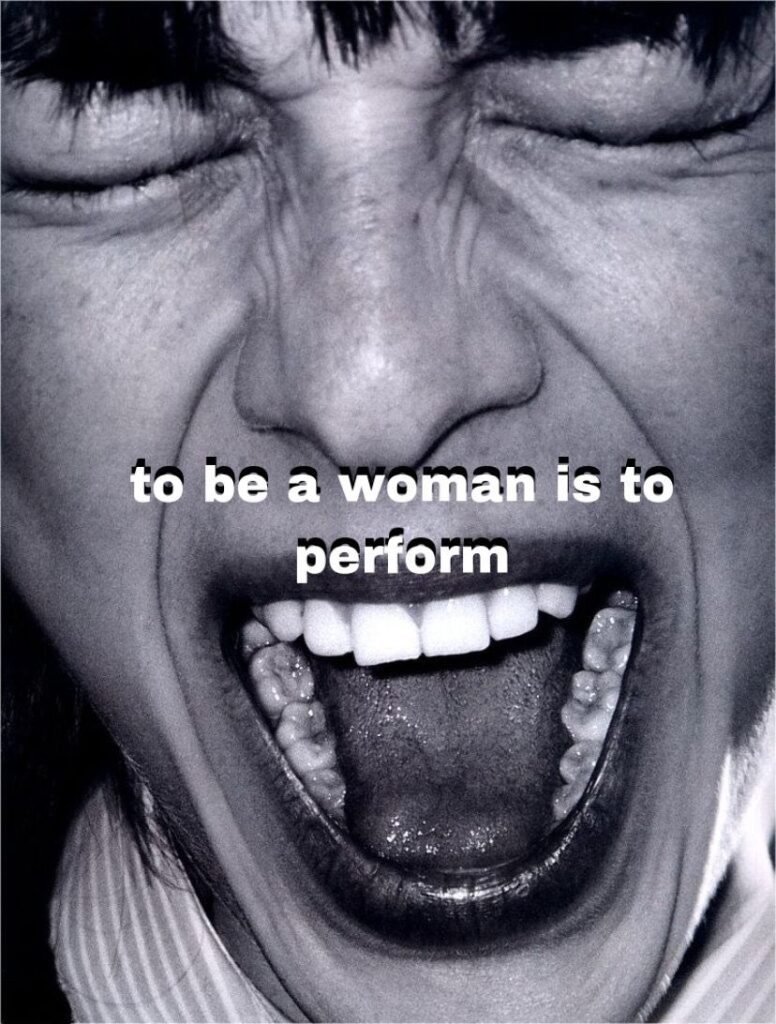

As I mentioned in a previous chapter, I’ve learned the art of performing from a very early age. But I didn’t know it was performing nor even thought that I was acting for a second.
Even though most of my performance was tied to the future husband that I was taught to desperately want, it wasn’t all about him after all. I didn’t have to perform just when there was a boy my age in the room ‘just in case’. My performance was meant for the whole world to see.
Being taught that everyone’s opinion mattered, meant that I had to put a pretty act in every moment that I could be potentially seen by anyone. The lady at the corner store, my grandma’s friends, the neighbors, my classmates and of course, even strangers. The way that I presented myself to the world was crucial because God forbid someone thought of me as an unpleasant creature. My role in society was to be easy to get along with and make a nice impression. It wasn’t all about me, I was representing my whole family. So, every time I met someone that could potentially know any of my family members, I had to put my best act, so I wouldn’t shame them.
Given the circumstances, this infinite performance that wasn’t even acknowledged as an act, changed my brain in ways that I still fight to heal.
Being by yourself and still acting as if the room was full of people isn’t for the weak. Instead of learning how to enjoy my alone time and the beauty the whole world around me has to offer, my brain would obsessively replay scenarios so that I could know how to react properly in case of anything. My reactions were carefully crafted by scenarios I made up every day instead of enjoying my free time. Nothing was random. Each and every social interaction was meticulously calculated days, weeks, and even months ahead of time. Knowing that a special event was ahead meant calculating all the possible scenarios and preparing the most refined gestures and replies for each possible social interaction. Excitement turns quickly into anxiety when only 10 out of your 48 scenarios are good for you. WOW… Re-reading all of this explains the crippling social anxiety that I used to have when I was younger.
As I grew older, I realized that the scenario thing is pretty common amongst women. So is the need to satisfy everyone.
For some, the act of imagining social interactions might represent a form of escapism when times are tuff, or even when there is nothing to do, when you would rather daydream than get caught up in the endless doomscroll.
On the other hand, the endless unpaid performance cannot be a means of relaxation. Even though I started to realize that this isn’t normal around the age of 15, years of doing this were hard to unravel. The moment I realized that I had my life solely for the purpose of living it and not for being a robot meant to make everyone’s day better, everything changed. Of course, my highly promoted acting career wasn’t over, but my roles started to get fewer and fewer the more inner work I’ve done. It took me years to start living for myself, and I still struggle to do so when there are important decisions to make.
Even though I was lucky enough to see the pattern and start making a change at an early age, some of my peers weren’t as lucky.
It hurts hearing my friends worry about the opinion of someone who knows someone they know. Hours of overthinking over what their ex-friend might’ve said about them to a person that they might not even meet in this lifetime, instead of watching their favorite show or going for a walk in the park when the trees are blooming. Hours upon hours of monitoring who might’ve heard about them, and most importantly WHAT they might have heard. For what? These people don’t make any true contributions to their lives. They don’t help them financially, they don’t give advice when needed, and they don’t care even whether they exist or not. So why bother?
When telling this part of my cheering up speech to my friends I often got the question. The burning question that leads to all this worrying: ‘What if I ever meet them?’
‘So what?’ I always tell them fuming. ‘Would you want to have a person in your life who rejects you merely because they have heard a lie about you? And as a matter of fact, most of the time the lie is a bad, obnoxious one. Is that the kind of person you want in your life?’.
This approach is often working when it comes to making people realize that they worry about something that they shouldn’t even have thought about twice.